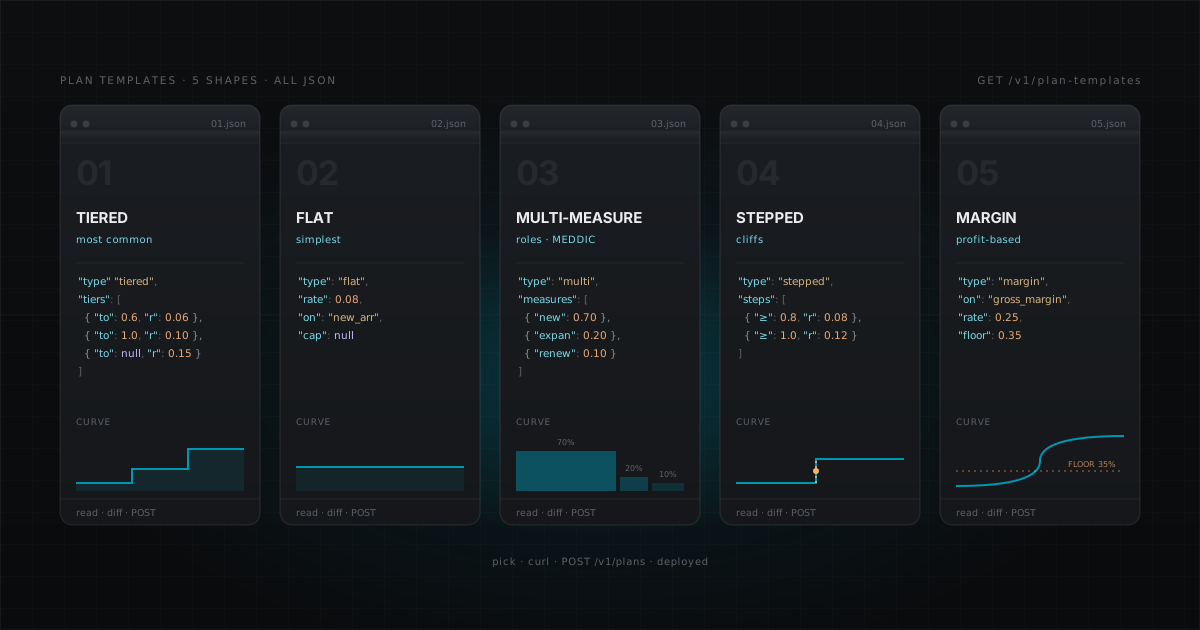
Five plan shapes, each as a JSON config
Every SaaS sales team needs a commission plan that drives the right behavior. Here are five real plan types, each with a deployable JSON config you can send straight to the CompCode API.
Commission plan design is where strategy meets execution. The wrong structure overpays closers who cherry-pick easy deals. The right one aligns every rep's incentives with what the business actually needs. Most teams end up with some variant of these five patterns.
Each example below includes the actual JSON config you would POST to /v1/plans in CompCode. These are not pseudocode. They are production configs using CompCode's commission-as-code rules engine.
1. Standard tiered rate plan
Use case: The default for most SaaS AE roles. Reps earn a percentage of the deal's Annual Contract Value (ACV), with the rate increasing as they hit quota milestones. This rewards over-performance without capping earnings, while keeping the plan simple enough that a rep can sanity-check their own paycheck.
How it works: Below quota, the rep earns 10% on every dollar booked. At 100% attainment, the rate jumps to 15%. Above 120%, it accelerates to 20%. The engine matches the rep's current attainment to the appropriate tier and applies that tier's rate to the deal's measure. The accelerator is the lever that turns the marginal dollar above quota into a stronger incentive than the dollars below it.
{
  "name": "AE Standard Tiered Plan",
  "version": 1,
  "effectiveStart": "2026-04-01",
  "rules": [
    {
      "name": "ACV Commission",
      "measure": "closed_won_revenue",
      "attainmentPeriod": "quarterly",
      "tierBy": "attainment",
      "tierMode": "full_rate",
      "tiers": [
        { "tierIndex": 0, "minThreshold": 0,   "rate": 0.10 },
        { "tierIndex": 1, "minThreshold": 1.0, "rate": 0.15 },
        { "tierIndex": 2, "minThreshold": 1.2, "rate": 0.20 }
      ]
    }
  ]
}
A rep who closes $50,000 in a quarter with a $100,000 quota (50% attainment) earns $5,000. The same rep closing $120,000 would earn $10,000 on the first $100K at 10%, then $3,000 on the next $20K at 15%, totaling $13,000. The accelerator makes the marginal dollar above quota significantly more valuable.
2. Flat bonus per new logo
Use case: Companies prioritizing customer acquisition over deal size. Common for PLG-to-sales motions where initial contracts are small but land-and-expand is the long game. Also used as a SPIF (Sales Performance Incentive Fund) layered on top of a base plan, so reps get a kicker for the deals that matter most strategically.
How it works: A single-tier rule with a flatAmount on the tier pays a fixed dollar amount for every qualifying deal when payoutBase is set to "1" (each event counts as 1, so payout = 1 × flatAmount). The conditions array filters which deals qualify. In this case, only deals tagged as "New Business" in the CRM. The plan is simple to explain to reps and simple to model financially because every qualifying deal costs you the same flat amount regardless of contract value.
{
  "name": "New Logo Bonus",
  "version": 1,
  "effectiveStart": "2026-04-01",
  "rules": [
    {
      "name": "New Customer Bonus",
      "measure": "deal_count",
      "payoutBase": "1",
      "attainmentPeriod": "monthly",
      "tierBy": "attainment",
      "conditions": [
        { "field": "deal_type", "fieldType": "select", "operator": "equals", "value": "New Business" }
      ],
      "tiers": [
        { "tierIndex": 0, "minThreshold": 0, "flatAmount": 500 }
      ]
    }
  ]
}
Every time a rep closes a deal where deal_type equals "New Business", they earn $500 regardless of the deal's value. A rep who closes 8 new logos in a month earns $4,000 from this rule alone. This plan is often combined with a tiered rate plan using CompCode's multi-rule system. The rep earns both the percentage commission and the flat bonus on qualifying deals.
3. Multi-measure plan (ACV + expansion)
Use case: Teams that need reps to balance new business with expansion revenue. The classic problem: if you only pay on new ACV, reps ignore upsells. If you only pay on total bookings, they farm existing accounts. A multi-measure plan solves this by weighting each metric independently and tracking attainment separately for each.
How it works: Each rule targets a different measure with its own quota and attainment calculation. Both rules apply tiered rates but filter deals by type using conditions, so the same engine produces two parallel commission streams that combine into one statement at month end. There is no single "weight" field: the relative dollar size of each rule's quota and rate schedule determines the effective split.
{
  "name": "AE Multi-Measure Plan",
  "version": 1,
  "effectiveStart": "2026-04-01",
  "rules": [
    {
      "name": "New ACV",
      "measure": "new_acv",
      "attainmentPeriod": "quarterly",
      "tierBy": "attainment",
      "tierMode": "full_rate",
      "tiers": [
        { "tierIndex": 0, "minThreshold": 0,   "rate": 0.10 },
        { "tierIndex": 1, "minThreshold": 1.0, "rate": 0.15 }
      ],
      "conditions": [
        { "field": "deal_type", "fieldType": "select", "operator": "equals", "value": "New Business" }
      ]
    },
    {
      "name": "Expansion Revenue",
      "measure": "expansion_revenue",
      "attainmentPeriod": "quarterly",
      "tierBy": "attainment",
      "tierMode": "full_rate",
      "tiers": [
        { "tierIndex": 0, "minThreshold": 0,   "rate": 0.08 },
        { "tierIndex": 1, "minThreshold": 1.0, "rate": 0.12 }
      ],
      "conditions": [
        { "field": "deal_type", "fieldType": "select", "operator": "equals", "value": "Expansion" }
      ]
    }
  ]
}
Each measure is tracked against its own quota set via POST /v1/quotas. If a rep has a $200K new ACV quota and a $100K expansion quota, they can be at 120% attainment on new business but only 80% on expansion. The final payout reflects both, rewarding balanced performance across the metrics that matter.
4. Quarterly stepped bonus
Use case: Milestone-based incentives where you want discrete payouts at specific attainment thresholds rather than a continuous rate. Common for SDR/BDR teams, customer success roles, or as a quarterly kicker on top of a monthly commission plan. Useful when you want to create clear goalposts that the rep can mentally anchor against.
How it works: Tiers carry a flatAmount instead of a rate, and the engine pays the rep the highest matching tier's flat amount once per period. Non-incremental: hit 100% attainment, earn $3,000. Not $1,000 + $3,000. This produces a cliff-edge incentive that pulls performance toward the threshold rather than spreading it evenly across the range.
{
  "name": "Quarterly Performance Bonus",
  "version": 1,
  "effectiveStart": "2026-04-01",
  "rules": [
    {
      "name": "Attainment Bonus",
      "measure": "closed_won_revenue",
      "payoutBase": "1",
      "attainmentPeriod": "quarterly",
      "tierBy": "attainment",
      "tierMode": "full_rate",
      "tiers": [
        { "tierIndex": 0, "minThreshold": 0.8, "flatAmount": 1000 },
        { "tierIndex": 1, "minThreshold": 1.0, "flatAmount": 3000 },
        { "tierIndex": 2, "minThreshold": 1.2, "flatAmount": 5000 }
      ]
    }
  ]
}
This creates clear goalposts. A rep at 79% attainment gets nothing, which is strong motivation to push one more deal across the line. The jump from $1,000 to $3,000 at quota makes hitting 100% feel disproportionately rewarding, which is exactly the point. The $5,000 tier at 120% rewards the top performers who consistently over-deliver.
5. Margin-based plan
Use case: Companies where not all revenue is equal. If your reps have pricing flexibility (discounting authority, custom packaging), a margin-based plan ensures they are optimizing for profitable deals, not just large ones. Particularly important in services-heavy SaaS where delivery costs vary by customer and discounting can quickly erase the profit on a headline-grabbing contract.
How it works: Instead of tiering by quota attainment, this plan tiers by the deal's margin percentage. Higher-margin deals earn a higher commission rate. Setting tierBy: "value" with tierValueField: "margin_percent" tells the engine to look up the margin field on each deal and match it to a tier, so each deal stands alone in how it gets paid. This requires the margin_percent field to be mapped from your CRM.
{
  "name": "Margin-Optimized Plan",
  "version": 1,
  "effectiveStart": "2026-04-01",
  "rules": [
    {
      "name": "Margin-Tiered Commission",
      "measure": "closed_won_revenue",
      "attainmentPeriod": "monthly",
      "tierBy": "value",
      "tierValueField": "margin_percent",
      "tierMode": "full_rate",
      "tiers": [
        { "tierIndex": 0, "minThreshold": 0,    "rate": 0.06 },
        { "tierIndex": 1, "minThreshold": 0.40, "rate": 0.09 },
        { "tierIndex": 2, "minThreshold": 0.60, "rate": 0.12 },
        { "tierIndex": 3, "minThreshold": 0.80, "rate": 0.15 }
      ]
    }
  ]
}
A $100,000 deal at 35% margin earns $6,000 (6% rate). The same deal at 70% margin earns $12,000 (12% rate). Reps quickly learn that protecting margin is worth more than negotiating a slightly larger topline number. This plan works best when your CRM tracks margin data and syncs it to CompCode via webhook integration.
Deploying these plans
Every example above is a valid CompCode plan config. To deploy one: send a POST /v1/plans request with the JSON body (see API docs), assign reps to the plan via POST /v1/assignments, set quotas via POST /v1/quotas (for attainment-based plans), and let deals flow in from your CRM via webhooks. Commissions calculate automatically from there.
Plans are versioned. Every PATCH /v1/plans/:id creates a new version with a change message, so you have a full audit trail of what changed, when, and why. No more "someone edited the plan in the UI and nobody noticed until payroll."
Need to combine multiple structures? Add more rules to the rules array. A rep can earn a tiered rate on ACV AND a flat bonus per new logo AND a quarterly stepped bonus, all within a single plan.
For more on why API-managed plans beat proprietary UIs, read API-First Commission Management: Why It Matters for Modern RevOps. To see how these plans work with your CRM, check out How to Set Up Commission Tracking in Attio. And for the full pricing details, we keep it simple.