Home / Use Cases / Enterprise commission plans: rate on revenue or target
Use Case

Two reps, the same $600,000, different payouts

Two account executives each close $600,000 in a quarter. One carries a $400,000 quota in a mature territory, the other carries $800,000 in the company's best region. A plan that pays a flat percentage of revenue pays them identically. A plan built on variable target pays the first one considerably more, and the second one considerably less. Both plans are defensible; only one of them is usually intended.

Start free → Read the quickstart Free for 10 reps. No credit card.
Marginal quarterly tier bands bounded by a floor gate and a cap multiplier
Pick a basis

What the commission is a percentage of

Enterprise plans have to answer what the commission is a percentage of.

A rate on revenue pays a percentage of what closed. It is easy to explain, easy to model, and it means the rep with the smallest quota earns the most per unit of effort. Where territories are genuinely comparable that is fine. Where they are not, the plan is paying for territory assignment rather than performance.

A multiple of variable target pays against the rep's own commission budget, scaled by how far past quota they finished. Two reps at 120 percent earn the same proportion of their own target, whatever the absolute revenue behind it. It normalises uneven territories at the cost of a plan that takes longer to explain.

Enterprise teams usually end up at the second, because enterprise territories are almost never comparable.

The same quarter, both bases

Both reps close $600,000 in the quarter. The first plan pays a flat 10 percent of revenue. The second pays a multiple of a $50,000 variable target, selected by the attainment each rep reached against their own quota. Only the quota differs between them.

Rep A Rep B
Quota $400,000 $800,000
Closed $600,000 $600,000
Attainment 150 percent 75 percent
Rate on revenue, 10 percent $60,000 $60,000
Multiple of $50,000 target $90,000 $0

The revenue-rate plan cannot tell the two quarters apart. Rep B missed quota by a quarter of a million dollars and earned exactly what Rep A earned for beating theirs by half.

The target-based column is deliberately harsh to make the mechanism visible: at 75 percent, Rep B sits under a 100 percent threshold and the accelerator pays nothing. In practice you would not run that structure without a band below quota, which is the next decision.

Guardrails

Floors and caps

A target-based plan needs bounds at both ends, and both are cost decisions rather than motivational ones.

A floor sets the attainment below which the rule pays nothing. It concentrates the variable budget on productive reps and makes a bad quarter's cost predictable. It also creates a cliff: a rep at 58 percent against a 60 percent floor earns zero, which in a business with nine-month cycles can turn one slipped deal into a resignation. Floors work best when the band immediately above them still pays something meaningful, so the gap between just-missing and just-making is not the entire variable component.

A cap bounds the top. Expressed as a multiple of variable target it scales with the role automatically, so the same plan works for a rep with a $40,000 target and one with $90,000. The number matters more than the mechanism. A cap set near expected performance reads to reps as a penalty for winning. A cap at two and a half times target only binds in outlier years, and mostly exists to stop one enormous deal consuming the annual commission budget.

Before you ship it

What breaks

Quota changes mid-period silently re-rate everything. When commission is a function of attainment, editing a quota changes every payout in that period, including ones already approved. Territory reshuffles and mid-year quota relief both do this. The plan should say whether a quota change applies from the change date or retroactively, because the engine will do whichever it is told.

A missing quota is worse than a zero quota. Attainment needs a denominator. If a rep has no quota row for the period, the calculation either fails or substitutes something, and a substituted default can produce payouts that look plausible and are wrong. Check quota coverage before running a period, not after.

Caps and floors interact with tier mode. A cap on a retroactive structure binds after the whole period has been re-rated, so the effective rate a rep sees can be much lower than the tier rate they crossed. If reps model their own plans, and enterprise reps do, expect that gap to be noticed.
The plan shape

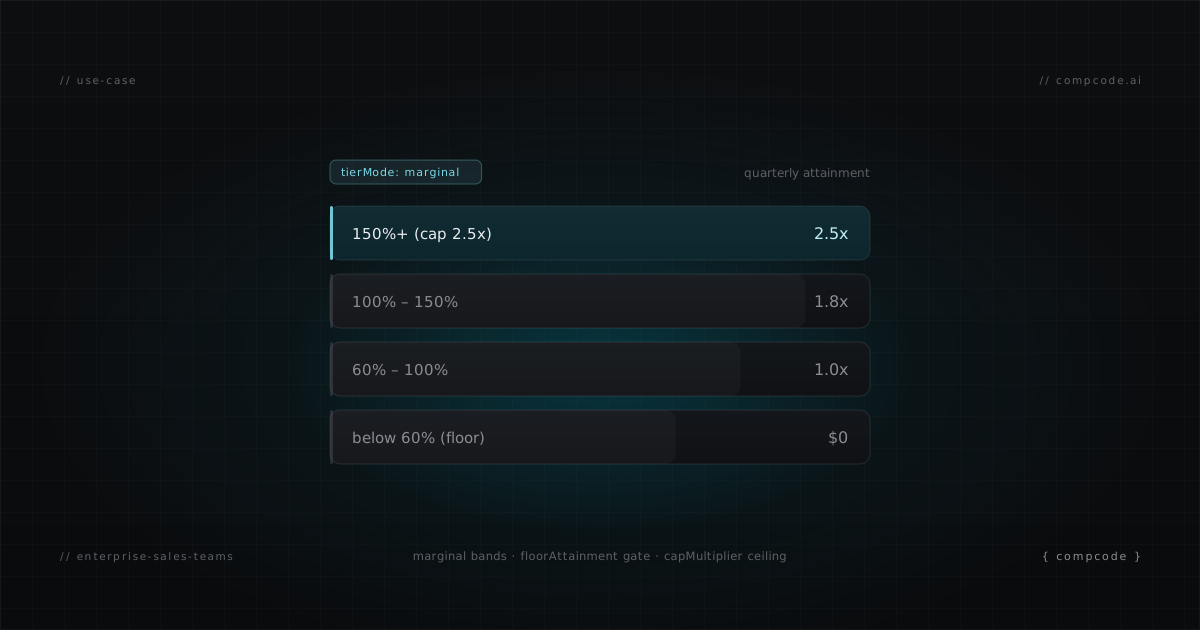
One rule carries all of it. It measures closed-won revenue, tracks quarterly attainment, pays a multiple of variable target rather than a percentage of revenue, and bounds the result with a floor and a cap. The tiers hold the multiples rather than percentages, which is what makes the payout scale with the role.

The floor and the cap are fields on the same rule as the tiers they bound, so the guardrails version together with the structure. Run the previous four quarters through it before switching: territory-normalised plans redistribute earnings between reps even when total cost stays flat, and it is better to know who moves before they find out from a statement.

This plan has one rule.

Quarterly Attainment

Pays a share of the rep's variable target (their commission budget for the period), with the rate chosen by quarterly quota attainment. Runs on every closed deal, as it closes.

AttainmentPays
60% to 100%1x variable target
100% to 150%1.8x variable target
150% and above2.5x variable target

Each band pays its own rate on the portion that falls inside it.

Nothing pays below 60% attainment. Payout is capped at 2.5x the variable target.

The same plan, as config

This is the whole plan. Send it to POST /v1/plans and it is live; change a rate and re-send it to ship a revision.

POST /v1/plans
curl -X POST https://api.compcode.ai/v1/plans \
  -H "Authorization: Bearer $COMPCODE_API_KEY" \
  -H "Content-Type: application/json" \
  -d '{
  "name": "Enterprise AE 2026",
  "effectiveStart": "2026-01-01",
  "config": {
    "rules": [
      {
        "name": "Quarterly Attainment",
        "measure": "closed_won_revenue",
        "executionPhase": "per_deal",
        "attainmentPeriod": "quarterly",
        "tierBy": "attainment",
        "tierMode": "marginal",
        "payoutBase": "variable_target",
        "floorAttainment": 0.6,
        "capMultiplier": 2.5,
        "tiers": [
          {
            "minThreshold": 0.6,
            "rate": 1
          },
          {
            "minThreshold": 1,
            "rate": 1.8
          },
          {
            "minThreshold": 1.5,
            "rate": 2.5
          }
        ]
      }
    ]
  }
}'
Questions

Common questions

Should enterprise commission pay a rate on revenue or a multiple of variable target?
Rate on revenue is simpler and pays every rep the same percentage of what they close, which quietly rewards whoever carries the smallest quota. Paying a multiple of variable target normalises for quota, so two reps who both hit 120 percent earn the same proportion of their own commission budget regardless of territory size. Enterprise teams with uneven territories usually need the second.
What is a commission floor and when should you use one?
A floor is a minimum attainment below which the rule pays nothing. It concentrates variable budget on reps who are productive and makes the cost of a weak quarter predictable. The trade-off is real: a rep at 58 percent against a 60 percent floor earns zero variable, which is a retention risk in long enterprise cycles where one slipped deal moves the number.
How do you cap enterprise commission without demotivating reps?
Express the cap as a multiple of variable target rather than a fixed dollar amount, so it scales with the role, and set it high enough that only genuine outliers reach it. A cap at 2.5x target means an exceptional year still pays two and a half times the commission budget. Caps set close to expected performance read as a penalty for winning.
Why do enterprise plans use quarterly rather than monthly attainment?
Enterprise cycles are long and lumpy, so a single deal can swing a monthly number from 20 percent to 180 percent and back. Measuring quarterly smooths that without stretching the feedback loop so far that the plan stops influencing behaviour. It also matches the period most enterprise quotas and forecasts are already set against.

Ship this plan today

Connect your CRM, create the plan with one call, and simulate before anyone gets paid.

Start free →