Home / Use Cases / Quota bonuses: lump sums against per-deal commission
Use Case

Paying at the finish line instead of on every deal

Per-deal commission and a period-end bonus can be tuned to cost the same amount over a year and still produce different sales behaviour every week. One pays for each deal as it lands. The other pays nothing until a line is crossed, and then pays all at once. The choice is about what you want a rep to do in the last three weeks of a quarter.

Start free → Read the quickstart Free for 10 reps. No credit card.
A periodic rule paying variable target times a tier multiplier at period end
Pick a rhythm

Continuous pay, or a finish line

Per-deal commission pays continuously. Every closed deal produces earnings, the rep sees a number move each time, and cash arrives steadily. It rewards volume and it rewards the deal in front of the rep right now.

A period-end bonus pays on reaching a threshold. Nothing accrues visibly until attainment crosses the line, and then a lump sum lands. It rewards finishing, which is a different thing from selling, and it is the natural structure for objectives that are not measured in revenue at all.

Most plans that work use both. A modest per-deal rate keeps cash flowing and the bonus carries the upside, so the rep is paid for activity and for outcome without either mechanism doing a job it is bad at.

The same year, three structures

Take a rep with a $20,000 quarterly variable target who finishes the year at 125 percent of a $500,000 quarterly quota. Below are three plans, each tuned to land near the same annual cost, so the comparison is about rhythm rather than about who is paid more overall.

Structure How it pays Annual total What the rep feels
Per-deal only, 5 percent 5 percent of $2,500,000 $125,000 Steady, every deal counts
Bonus only, 1.25x target 1.25 x $20,000, four quarters $100,000 Nothing, then everything
Split, 3 percent plus 0.5x bonus $75,000 plus $40,000 $115,000 Steady with a finish line

The annual figures are close. The experience is not. Under the bonus-only plan a rep who ends a quarter at 99 percent receives nothing for that quarter, having closed $495,000. Under the per-deal plan the same rep receives $24,750.

That cliff is the mechanism, not a flaw. It is also the reason bonus-only structures suit roles with predictable, controllable pipelines and punish roles where one customer's legal review decides the quarter.

Structure

Why a multiplier, not a fixed amount

A bonus can be written as a fixed dollar amount or as a multiple of the rep's variable target. The multiple is almost always better, for a reason that has nothing to do with motivation.

A fixed amount hard-codes a compensation band into the plan. Promote the rep, hire a senior version of the role, or adjust variable pay at the annual review, and the plan has to be re-authored. Teams that carry a dozen fixed bonus amounts across a dozen plans end up with plans that are silently out of date with the compensation model.

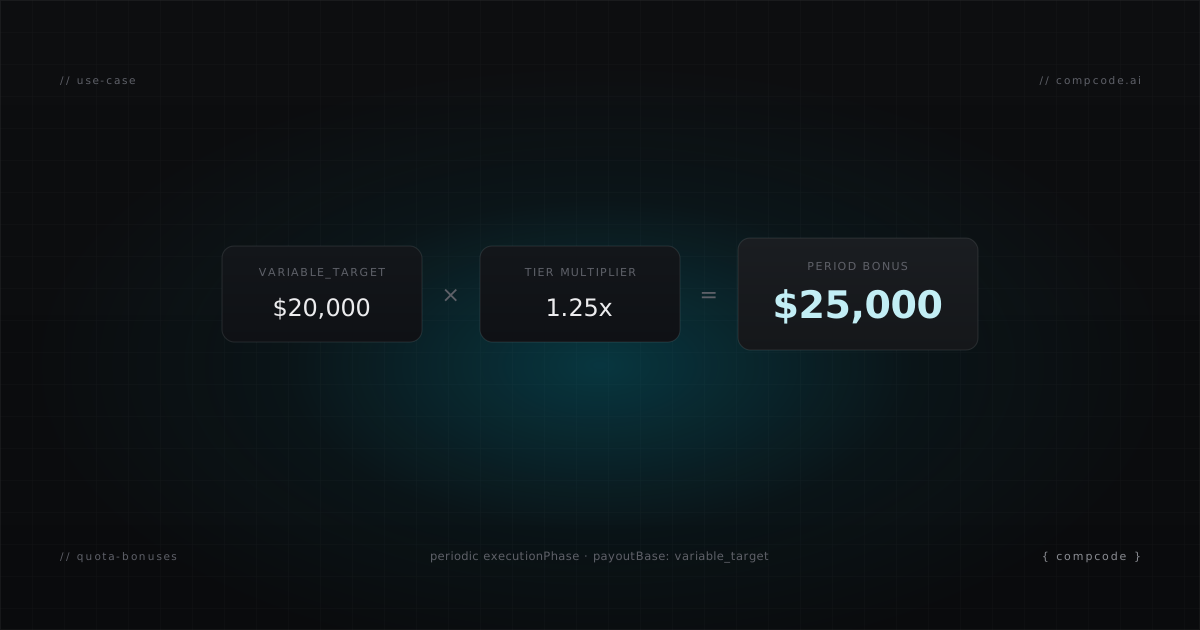
A multiplier applied to each rep's own variable target keeps the plan stable while the people move through it. The rep with a $20,000 target and the rep with $60,000 sit on the same plan and are paid proportionally, and a promotion changes the payout without anyone editing a rule.

Before you ship it

What breaks

A bonus rule pays once, so period boundaries matter more than usual. Per-deal rules are forgiving about exactly which day a deal lands, because the deal pays either way. A bonus is decided by attainment at the moment the period closes, so a deal that slips by two days can move the entire payout. Expect pressure on close dates near period end, and expect disputes about them.

Late deals reopen a closed period. A deal that arrives after the bonus has been calculated changes attainment and therefore changes whether the bonus was owed. Either the period is genuinely locked, and late deals count toward the next one, or it is not, and a paid statement can move. Both are workable, and the plan needs to say which.

Objectives that are not revenue still need a measurable target. MBO-style bonuses fail more often on measurement than on structure. Renewals retained, accounts onboarded, and certifications completed all work as bonus rules, and each needs a number that exists somewhere queryable at period end. Objectives that only a manager can assess belong in a separate process, not in an automated plan.
The plan shape

A period-end bonus is one rule with a different execution phase. Rather than running per deal, it evaluates once at the end of the period, reads the rep's attainment, and pays a multiple of their variable target. The tiers hold multipliers rather than percentages, so the same rule scales across compensation bands.

Adding a per-deal rate alongside it is a second rule in the same plan rather than a second system, which is what keeps the split structure to one statement and one approval. Price the split before adopting it: moving upside from per-deal into a bonus changes when reps are paid, and cash timing tends to generate more feedback than the annual total does.

This plan has one rule.

Period Bonus

Pays a share of the rep's variable target (their commission budget for the period), with the rate chosen by quarterly quota attainment. Runs once at the end of each quarter period, not per deal.

AttainmentPays
80% to 100%0.5x variable target
100% to 125%1x variable target
125% and above1.25x variable target

Crossing a tier re-rates the whole quarter at the higher rate, not just the revenue above it.

The same plan, as config

This is the whole plan. Send it to POST /v1/plans and it is live; change a rate and re-send it to ship a revision.

POST /v1/plans
curl -X POST https://api.compcode.ai/v1/plans \
  -H "Authorization: Bearer $COMPCODE_API_KEY" \
  -H "Content-Type: application/json" \
  -d '{
  "name": "Quota Bonus 2026",
  "effectiveStart": "2026-01-01",
  "config": {
    "rules": [
      {
        "name": "Period Bonus",
        "executionPhase": "periodic",
        "measure": "closed_won_revenue",
        "attainmentPeriod": "quarterly",
        "tierBy": "attainment",
        "tierMode": "full_rate",
        "payoutBase": "variable_target",
        "tiers": [
          {
            "minThreshold": 0.8,
            "rate": 0.5
          },
          {
            "minThreshold": 1,
            "rate": 1
          },
          {
            "minThreshold": 1.25,
            "rate": 1.25
          }
        ]
      }
    ]
  }
}'
Questions

Common questions

What is a quota bonus and how does it differ from commission?
A quota bonus pays a lump sum for reaching an attainment threshold in a period, rather than a percentage of each deal as it closes. Commission rewards volume continuously; a bonus rewards crossing a line once. Plans often use both, with a modest per-deal rate for cash flow and a bonus that carries most of the upside.
When should a plan use a period-end bonus instead of a per-deal rate?
When the behaviour you want is finishing the period rather than closing any individual deal. Bonuses suit roles with long cycles, small deal counts, or objectives that are not revenue at all, such as renewals retained or accounts onboarded. They are a poor fit where reps need frequent cash feedback to stay motivated.
How are MBOs handled alongside revenue commission?
As a separate rule in the same plan that pays at period end against its own target. Keeping it in one plan means one statement, one approval, and one version history, rather than a commission system plus a spreadsheet of objectives that reconcile by hand at the end of the quarter.
Why pay a bonus as a multiple of variable target rather than a fixed amount?
Because it scales with the role automatically. A multiplier applied to each rep's own variable target means the same plan works for a rep with a $20,000 target and one with $60,000, and a promotion changes the payout without changing the plan. Fixed amounts have to be re-authored every time compensation bands move.

Ship this plan today

Connect your CRM, create the plan with one call, and simulate before anyone gets paid.

Start free →