Home / Use Cases / Manager overrides: paying leads on their team's deals
Use Case
An override on revenue and on commission are not the same
A team lead earns something on the deals their reps close. Almost every plan says that, and almost none say what the something is a percentage of. One percent of team revenue and ten percent of team commission can produce nearly the same number for one quarter and then drift apart permanently, because they are driven by different things.
Manager overrides come in two shapes, and the difference only shows up when the team's performance is uneven.
A percentage of team revenue. The manager earns on what the team closed, regardless of what the reps were paid. Stable, easy to forecast, and unaffected by changes to rep plans. It also pays the same whether the team hit its number through one rep at 200 percent or four reps at 100.
A share of team commission. The manager earns a proportion of what the reps earned. When reps cross accelerators the manager rises with them. It ties the manager to rep outcomes, which is usually the point of having a manager, and it couples manager pay to every future rep-plan change.
The same team, both bases
A team of four closes $2,000,000 in a quarter. The reps are on a tiered plan and earned $184,000 between them, because two crossed an accelerator and two did not.
Override base
Calculation
Manager earns
1 percent of team revenue
1 percent of $2,000,000
$20,000
10 percent of team commission
10 percent of $184,000
$18,400
Close enough to look interchangeable. Now hold revenue flat and change the mix: the same $2,000,000, closed by four reps who each land at 95 percent, so nobody reaches an accelerator and rep commission totals $150,000.
Override base
Calculation
Manager earns
1 percent of team revenue
1 percent of $2,000,000
$20,000
10 percent of team commission
10 percent of $150,000
$15,000
Identical revenue, and the commission-based override is now 25 percent lower. That is the structure working as intended: it pays the manager for reps clearing quota, not for the team hitting a revenue total. Whether you want that is the actual decision.
Per-rep rates
The exception that creates two plans
Separately from the override, most teams eventually have one rep on a negotiated rate. A senior hire took 12 percent where the team is on 10, or someone kept their old rate through a reorganisation.
The common response is to clone the plan, change the number, and assign that rep to the copy. It works on the day it is done. The problem arrives at the next plan change, when someone updates the main plan and does not update the copy. A year later nobody is certain which is authoritative, and the difference surfaces through a dispute rather than a review.
The alternative is a tier row scoped to a single rep inside the shared plan. The exception sits next to the standard rate rather than in a separate document, so a future change is made once and applies to everyone including the exception. One plan stays one plan.
Before you ship it
What breaks
Player-coaches can be paid twice on one deal. A manager who carries personal quota and a team override will earn as the deal owner and again through the hierarchy unless the rules say otherwise. Decide explicitly whether a manager's own deals feed their override, because both answers are reasonable and only one of them is what you budgeted.
Overrides go stale when the org chart moves. An override that walks the reporting hierarchy pays whoever is the manager at calculation time, so a reorganisation mid-quarter changes who earns on deals closed before it. Rules scoped to a manager's direct reports follow that change automatically, which is usually right and occasionally surprising, so it should be stated rather than discovered.
Commission-based overrides recalculate when rep plans change. If manager pay is a share of rep commission, fixing a rep's rate retroactively also moves the manager's earnings for that period. That is arithmetically correct, and it means a rep correction is never only a rep correction.
The plan shape
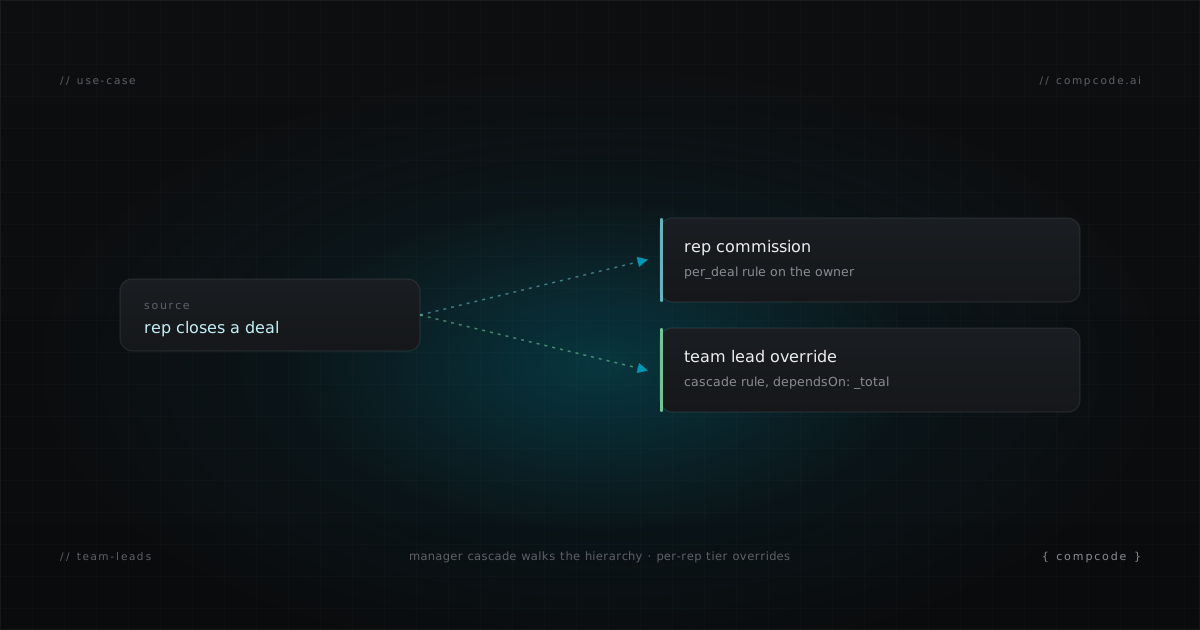
Two rules in one plan. The first pays reps on the deals they own and carries a rep-scoped tier row for the negotiated exception. The second runs after the first and pays the team lead a share of what the rep earned, which is what makes it a commission-based override rather than a revenue-based one.
Switching to a revenue-based override means pointing the second rule at revenue instead of depending on the first rule's output. That is a one-field change here and a new spreadsheet everywhere else, which is the practical argument for keeping the structure in config: both versions can be priced against a real quarter before either is committed to.
This plan has 2 rules, all in a single config.
Rep ACV
Pays a share of closed-won revenue. Runs on every closed deal, as it closes.
Attainment
Pays
0% and above
10% of closed-won revenue
Crossing a tier re-rates the whole quarter at the higher rate, not just the revenue above it.
One rep carries a personal rate (12%) as an extra tier row scoped to their id, so the rest of the team stays on one shared plan.
Team Lead Override
Pays a share of closed-won revenue. Runs after the rep's own commission is calculated, paying the manager on the same deal.
Attainment
Pays
0% and above
2% of closed-won revenue
The same plan, as config
This is the whole plan. Send it to POST /v1/plans and it is live; change a rate and re-send it to ship a revision.
Two structures dominate. An override on team revenue pays the manager a percentage of what the team closes, independent of what the reps earned. An override on team commission pays a share of the reps' payouts, so the manager's number moves with the reps' rates and accelerators. They produce different numbers on the same team and reward different behaviour.
Should a manager's override be based on revenue or on rep commission?
Revenue-based overrides are simpler and stay stable when rep plans change. Commission-based overrides align the manager with rep outcomes, so a manager earns more when reps hit accelerators, which is usually the behaviour you want from someone coaching a team. The cost is coupling: every change to a rep plan changes manager pay too.
Can one rep have a different commission rate without cloning the plan?
Yes, with a tier row scoped to that rep inside the shared plan. The negotiated rate lives beside the standard one rather than in a second copy, so a future change is made once. Cloning a plan for one exception is what produces two plans that slowly stop matching.
Do managers earn on their own deals as well as their team's?
Often yes, and it needs to be explicit. A player-coach who carries personal quota and a team override can be paid twice on the same deal if the rules are not scoped, once as the owner and once through the hierarchy. Deciding whether a manager's own deals feed their override is a design choice, not an implementation detail.
Ship this plan today
Connect your CRM, create the plan with one call, and simulate before anyone gets paid.