Home / Use Cases / Usage-based commission: paying on revenue that moves
Use Case

The number you closed is not the number you bill

A consumption deal closes at one number and bills at another. The commitment says $30,000, the first quarter bills $52,000, and by month nine the account is running at $120,000 annualised. Every one of those is a defensible basis for commission, and they pay the rep very differently. Most consumption comp plans never say which one they mean.

Start free → Read the quickstart Free for 10 reps. No credit card.
Value-based tier ladder paying each consumption band its own marginal rate
Pick a moment

When does the revenue become real

Commission needs a number, and consumption revenue does not hold still long enough to give you one. So the plan has to name the moment revenue becomes real.

At close. Pay on the committed or estimated amount the day the deal is won. Simple, fast, and familiar to anyone who has run a seat-based plan. It also pays the same commission whether the customer goes on to consume nothing or triple the commitment.

At first full billing period. Wait until one complete cycle has billed, then pay on that. More accurate, delays the rep's cash by a month or a quarter, and still misses everything that happens afterwards.

Continuously. Recalculate as usage lands, so the commission tracks the account. Most accurate, and the only option that pays growth. It also means a paid commission can change.

The same customer, three ways

Take one customer, closed in January on a $30,000 commitment and consuming steadily above it all year. Hold the rate constant at 8 percent and change only the basis the rate is applied to, across the first twelve months. The three answers are all defensible and none of them are close.

Basis Revenue used Commission What the rep learns
At close $30,000 committed $2,400 Land the logo, move on
First billing period $52,000 annualised $4,160 Land it and get it live
Continuous $120,000 actual $9,600 Land it, get it live, grow it

The spread is not a rounding difference. Paying at close values this customer at a quarter of what continuous valuation does, and it pays exactly the same whether the account grows or stalls.

That is the real argument for continuous recalculation, and it is a behavioural one rather than an accounting one. If expansion is what the business needs and the plan pays at close, the plan is buying logos.

Structure

Why value tiers, not attainment tiers

Once you are paying on actual consumption, the next question is what selects the rate. The instinct is to use quota attainment, because that is how most plans work. For consumption it is usually the wrong driver.

Attainment tiers make the same customer worth different amounts to different reps. A $200,000 account lands in a high band for a rep at 130 percent and a low band for a rep at 60 percent, so the payout says more about the rep's quarter than about the account. In a motion where the goal is growing accounts, that noise works against you.

Value tiers read the consumption number on the account itself. A band is a band regardless of who owns it, so growing an account from $75,000 to $150,000 pays the same to anyone. Combined with marginal bands, each slice of consumption pays its own rate and the incentive rises smoothly with account size instead of stepping at a quota line.

Before you ship it

What breaks

Continuous recalculation is the right answer for most consumption businesses and it introduces three problems that per-deal plans never have.

Usage falls, and so does a commission you already paid. A customer that drops from $120,000 to $70,000 takes the rep's earned commission down with it. This is arithmetically correct and it is the single most disputed thing in consumption comp. Decide up front whether adjustments are capped, whether a floor protects previously paid amounts, and how far back a correction can reach, then write it in the plan rather than settling it per case.

The rep's number changes without anyone touching it. In a seat-based plan a commission only moves when a human edits something. Here it moves because a customer ran more queries. Statements have to show which usage figure produced which payout and when it was last recalculated, or every conversation starts from zero trust.

Month-end stops being a close and becomes a snapshot. There is no moment when consumption is final, so the period close is a decision about which usage reading you are paying on. Pick a cutoff, apply it consistently, and expect the following period to carry adjustments from the previous one.
The plan shape

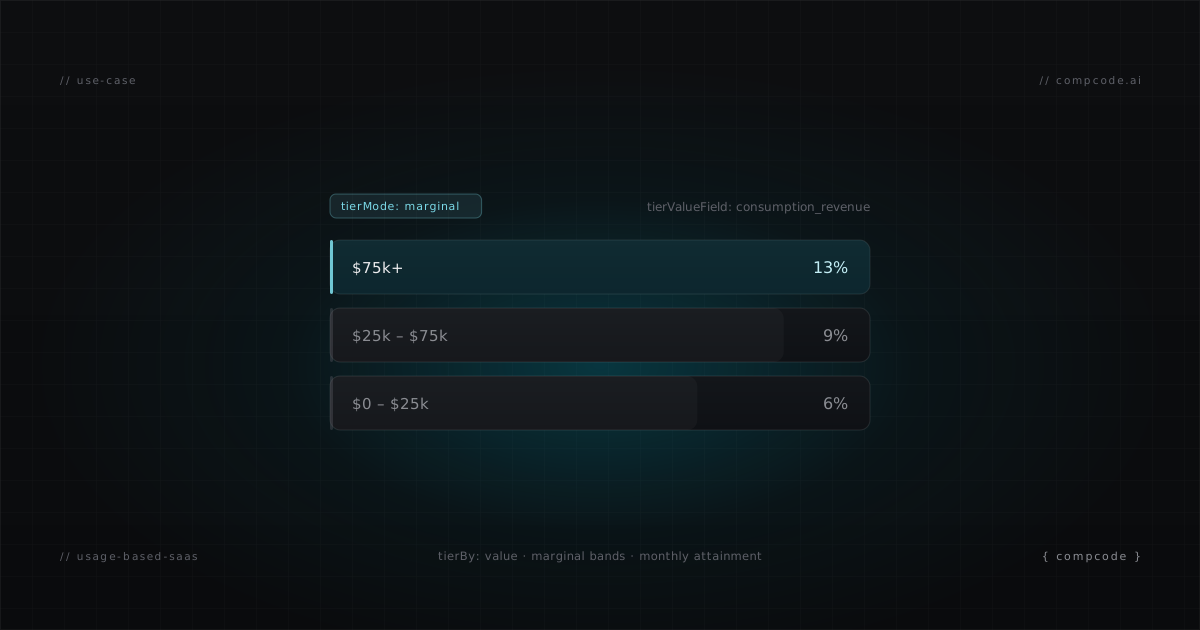
One rule does this. It measures the consumption revenue field rather than a closed-won amount, tiers by the value of that field instead of by attainment, and uses marginal bands so each slice of consumption pays its own rate. Monthly attainment keeps the recalculation window short enough that corrections stay small.

Because the rule reads a field rather than a snapshot, a change to consumption re-runs the same calculation and updates the commission in place, with the previous value kept in history. Run it against a period you have already paid before switching anything over, so you can see how large the corrections would have been on real accounts.

This plan has one rule.

Usage Revenue

Pays a share of consumption revenue, with the rate chosen by the deal's consumption revenue. Runs on every closed deal, as it closes.

Deal valuePays
$0 to $25,0006% of consumption revenue
$25,000 to $75,0009% of consumption revenue
$75,000 and above13% of consumption revenue

Each band pays its own rate on the portion that falls inside it.

The same plan, as config

This is the whole plan. Send it to POST /v1/plans and it is live; change a rate and re-send it to ship a revision.

POST /v1/plans
curl -X POST https://api.compcode.ai/v1/plans \
  -H "Authorization: Bearer $COMPCODE_API_KEY" \
  -H "Content-Type: application/json" \
  -d '{
  "name": "Consumption AE 2026",
  "effectiveStart": "2026-01-01",
  "config": {
    "rules": [
      {
        "name": "Usage Revenue",
        "measure": "consumption_revenue",
        "executionPhase": "per_deal",
        "attainmentPeriod": "monthly",
        "tierBy": "value",
        "tierValueField": "consumption_revenue",
        "tierMode": "marginal",
        "tiers": [
          {
            "minThreshold": 0,
            "rate": 0.06
          },
          {
            "minThreshold": 25000,
            "rate": 0.09
          },
          {
            "minThreshold": 75000,
            "rate": 0.13
          }
        ]
      }
    ]
  }
}'
Questions

Common questions

How do you calculate commission on usage-based revenue?
Pick the moment the revenue becomes real and pay against that. The three common choices are the committed amount at close, the first full billing period, and continuous recalculation as consumption lands. Continuous recalculation is the most accurate and the most operationally demanding, because every change to a customer's usage changes a commission that may already have been paid.
Should consumption commission use attainment tiers or value tiers?
Value tiers read the usage number on the account directly, so a customer consuming $80,000 lands in a band because of what they consumed, not because of where the rep sits against quota. Attainment tiers make the same customer worth different amounts to different reps, which is usually the wrong incentive for a consumption motion where account growth is the goal.
What happens to commission when a customer's usage drops?
Payout falls with it if you are recalculating continuously, which means a negative adjustment against a rep who may already have been paid. Plans that do not state this in advance tend to resolve the argument in the rep's favour. Deciding the floor, the true-up cadence, and whether adjustments are capped is part of designing the plan, not an operational detail.
Why do legacy commission tools struggle with consumption revenue?
Most were built around a closed-won amount that does not change, so they snapshot the deal at close and treat later movement as a correction. When the underlying number moves every month, corrections stop being exceptional and become the normal case, and the reconciliation work grows with the customer base rather than with the deal count.

Ship this plan today

Connect your CRM, create the plan with one call, and simulate before anyone gets paid.

Start free →